Palindrome Partitioning asks for every way to cut a string s so that each piece is itself a palindrome. Unlike Two Sum or Group Anagrams, there's no single clever data structure that solves it in one pass — the honest answer is that you have to explore the whole search space, and the interview signal is in how cleanly you do that.
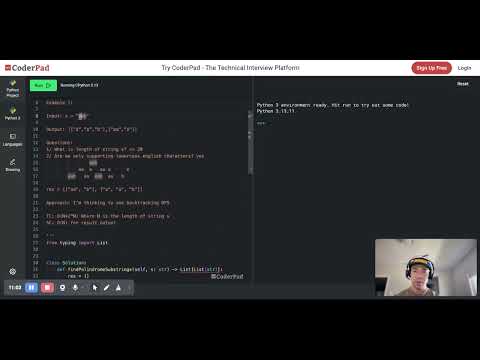
The backtracking shape
At each position, try every prefix starting there. If that prefix is a palindrome, keep it as one piece and recurse on the rest of the string. If it isn't, skip it and try a longer prefix. When you reach the end of the string, the pieces you've collected along the current path are one valid partition.
function backtrack(start, path):
    if start == len(s):
        result.append(path.copy())
        return
    for end in start+1 .. len(s):
        piece = s[start:end]
        if isPalindrome(piece):
            path.append(piece)
            backtrack(end, path)
            path.pop()
This is plain backtracking: choose, recurse, undo. The only interesting decision is what counts as a valid choice at each step, which is exactly the palindrome check.
The naive palindrome check is the bottleneck
Checking whether a substring is a palindrome by walking it from both ends is O(n) per check. Since backtracking already explores an exponential number of partitions, doing an O(n) check at every branch multiplies an already-expensive search by another factor of n for no reason — the string itself doesn't change between calls, so the same substrings get re-checked over and over across different branches.
Precompute palindromes with DP
Build a table isPal[i][j] that answers "is s[i..j] a palindrome" in O(1), filled once up front in O(n^2):
isPal[i][i] = true                          // single char
isPal[i][i+1] = (s[i] == s[i+1])             // two chars
isPal[i][j] = (s[i] == s[j]) and isPal[i+1][j-1]   // general case
Filling this table by increasing substring length (so isPal[i+1][j-1] is already known) turns every palindrome check inside the backtracking loop into a single array lookup. The backtracking still has to enumerate every valid partition — that part is inherently exponential in the worst case (a string of all the same character has an exponential number of valid partitions) — but the table removes the redundant work of re-deriving the same palindrome facts from scratch on every branch.
Complexity
With the table: O(n^2) to build it, and the backtracking itself is bounded by the number of partitions times the work to copy each one, which is the part of the problem that's genuinely exponential — no algorithm avoids it, since the output size itself can be exponential. The DP table is what keeps the per-step cost down to O(1) instead of O(n), which is the difference between a solution that passes and one that times out on longer strings.
The follow-up interviewers ask
Once you have this working, the natural next question is LeetCode 132, Palindrome Partitioning II: instead of returning every partition, return the minimum number of cuts needed. That's a different DP on top of the same isPal table — minCuts[j] is the fewest cuts needed for s[0..j], computed as min(minCuts[i-1] + 1) over every i <= j where s[i..j] is a palindrome. Having the palindrome table already built makes that second DP a short addition rather than a rewrite, which is usually the point of asking it.